In this blog, we are going to break down the naming of plants. It is not as simple as one thinks! The reason that scientists go to all this effort to name plants in this way is to prevent confusion. Common names of plants in South Africa differ from common names in other countries. This means if you were speaking to someone from Japan that did not know Afrikaans, and told them you had a ‘perdetande’ succulent, they would have no idea what you meant! But if you mention Haworthia truncata, they would be able to look it up for themselves and understand which plant you have. This is why scientific names are useful.
Classy classifications
There are several classification levels that life falls into. These are called taxonomic ranks. There are domains, kingdoms, phylums, classes, orders, families, genera (genus), and species. There are even further sub-classifications for certain levels, such as subspecies. Generally, for the average succulent enthusiast, the only two important ones to remember are the genus and species. That is what this blog will be delving into. Before we begin, remember to always write scientific names in italics.
Don’t look a gift horse in the mouth…
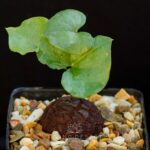
As an example, let’s take the ever popular Haworthia truncata (“perdetande” or “horse’s teeth”).
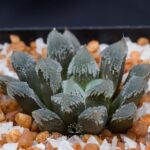
The genus of this plant is Haworthia, which in layman’s terms is the “family name” of the plant (though this is not the same as the family, in the scientific sense). This is the first portion of the scientific name, and the first letter of the genus name is always capitalized. The genus includes many individual species, many of which can seem wildly different, even if they belong to the same “family”.
The species name of this plant is truncata. As the species name is lower in taxonomic ranking than the genus, it is not capitalized. So, it is not “Haworthia Truncata” as in a human name and surname, it is “Haworthia truncata”.
Variety is the spice of life
‘Varieties’ are another level of classification that also form part of plant’s scientific names. A variety is a type within a species that is similar to, but distinct from, the original species. It is however too dissimilar to be classified as purely the original species. When talking about varieties, the full species name of the above plant is H. truncata var. truncata. Another variety is H. truncata var. minor (also called H. pappilaris by some experts).
Form over function
Forms are similar to varieties, but they are more closely relatable to the original species. H. truncata forma crassa is one form of the original species. Much like the genus, note that it is written “forma” in the initial typing and can then be shortened to “f.”. Therefore: H. truncata f. Crassa.
We shortned Haworthia to just ‘H.‘ a few times. Did you notice? The problem with these long names is that repeatedly typing it out in full can become quite tiresome. So, one can write the initial use of the name in full (Haworthia truncata), and any later mentions of the same species can be shortened to “H. truncata”.
Nature’s beauty
For the lucky few people that originally described a plant from a specimen they discovered in nature, or for those that found a specific new growing location for a species, a plant usually has something called locality data attached to its name. For example, Haworthia picta var. janvlokii GM 267. This indicates the catalogue number of the plant described by Mr. Marx. There are also descriptors for Bruce Bayer (MBB), Ingo Breuer (IB) and various others.
Captivating cultivars
One can also go further in depth than just the naturally grown genus and species. Specialist growers can name individual, unique varieties of plants that they have bred in their greenhouse.
A plant grower can decide to give a plant they have personally bred, or any plant they find to be interesting, a unique name. For example, one can have a H. truncata var. truncata with a cultivar name of “Araiso”, which would then be shortened to H. truncata ‘Araiso’, or even just Haworthia ‘Araiso’. The dedicated breeders can also decide to register their cultivar names officially, so that only their plants can have that specific name.
Written by Harry Lewis, succulent specialist & conservationist