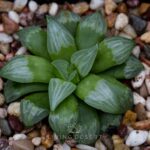
Aloe castilloniae
Aloe castilloniae forms a small, creeping rosette of recurved, dark green leaves heavily armed with bright orange-red, tooth-like marginal spines. This miniature succulent separates itself from other dwarf aloes by holding these prominent, sharp tubercles on both the upper and lower leaf surfaces. The stems twist and trail downwards over time, forming a dense, prickly cluster that flushes deep bronze under intense sunlight.
Origin and Natural Habitat
This species occurs natively in a highly restricted locality in the Sofia region of northwestern Madagascar. The plants colonize steep, vertical limestone cliffs and tsingy formations, growing wedged into narrow rock crevices and pockets of leaf litter. They survive a tropical dry climate marked by a wet summer season and a prolonged, bone-dry winter period. The cliffside positioning provides exceptional drainage, keeping the roots safe from standing water during heavy tropical downpours while the surrounding rocks shield the root zone from intense solar heat.
Plant Characteristics
The low-growing rosettes of Aloe castilloniae reach individual diameters of 5 cm to 8 cm, offsetting profusely from the base to trail down rock faces. The deeply channeled leaves curve backward sharply, creating a distinct claw-like appearance emphasized by the bright red marginal teeth. It produces unbranched, horizontal or pendulous flower racemes up to 15 cm long during the summer months. These thin stalks bear small, tubular green-tipped orange flowers. The plant maintains a lean but tough root system that anchors firmly into rock fissures to absorb minimal moisture efficiently.
Care Guide
Light
This Madagascan succulent requires bright, indirect sunlight or filtered morning sun to maintain its deep bronze coloration and compact, claw-like shape. Provide a 40% shade cloth cover inside a professional greenhouse environment. Avoid direct midday summer sun in hot climates, as excessive solar radiation scorches the leaf tips and turns the foliage a stressed, sickly yellow-brown.
Soil
The roots require an exceptionally open mineral potting medium to eliminate any risk of moisture retention. The LDP Super Drainage Mix provides the perfect gravelly foundation for this cliff-dwelling species. Never use standard potting mixes that contain heavy peat or uncomposted organic matter.
Water
Water the plant thoroughly during the warm spring and summer months only when the mineral substrate dries out completely down to the bottom of the pot. Follow the standard soak and dry method faithfully. Reduce watering significantly during autumn and keep the substrate almost completely dry throughout winter to mirror its natural dry-season dormancy.
Pot size
Select a shallow terracotta container or a hanging basket that accommodates the trailing growth habit of the stems. Terracotta allows moisture to evaporate evenly through the porous clay walls, preventing stagnant water pockets. Leave roughly 3 cm of open space around the perimeter to allow the offsets to cascade over the sides naturally.
Temperature
This species thrives in warm conditions between 18°C and 30°C. It lacks frost tolerance and requires total protection against cold winter temperatures below 10°C. Move the container to a warm, bright indoor windowsill or under heated greenhouse benches during winter.
Humidity
Maintain low to moderate humidity levels with active air circulation across the growing area. Stagnant, humid conditions coupled with cool temperatures invite fungal pathogens that rot the leaf joints and soften the stem bases. Open greenhouse vents or use a small fan to keep the air moving constantly around the plant canopy.
Fertilizing
Apply a balanced liquid fertilizer diluted to one-quarter strength only twice a year, once in early summer and once in mid-summer. Do not feed the plant during winter dormancy. Excessive nitrogen levels cause the compact rosettes to bloat and stretch, permanently ruining the tight leaf arrangement and weakening the spine development.
Growing Season
Aloe castilloniae grows actively during the warm spring and summer months, responding well to regular watering and warm night temperatures. It enters a sluggish, semi-dormant state during autumn and stays fully dormant during winter. The plant requires minimal moisture, high ventilation, and protection from cold air to get through its winter rest safely.
Propagation
You can propagate this rare species successfully by separating basal offsets or by taking stem cuttings.
Basal Offsets
Gently detach a mature offset from the base of the main cluster during the active spring growing period using a sterile blade. Ensure the pup retains a portion of its own root system where possible. Allow the detached offset to dry in a ventilated room for five days until a firm callus forms over the wound. Plant the rooted offset directly into a fresh pot of mineral mix and withhold water for one week to allow the tissue to settle before watering.
Stem Cuttings
Cut a trailing stem cleanly away from the parent plant during early summer using a sharp, sterile knife. Remove the lower leaves carefully to expose 2 cm of bare stem. Allow the cutting to rest in a dry, shaded area for seven to ten days until a thick callus seals the cut end. Insert the callused stem upright into a pot of dry pumice or quartz grit, keeping it in a warm, bright position. Avoid watering until the cutting produces new roots after several weeks.