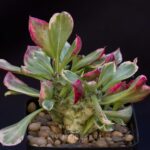
Gasteria armstrongii
Gasteria armstrongii is a slow-growing, succulent perennial in the family Asphodelaceae. It is distinguished by its distichous growth habit, meaning the leaves grow in two opposite ranks, creating a flattened appearance. The leaves are thick, leathery, and dark green to almost black, often featuring a rough, tuberculate surface texture. This species is highly sought after for its compact size over many years.
Origin and Natural Habitat
This species is endemic to a very restricted range in the Eastern Cape, South Africa, primarily occurring near the Humansdorp area. It inhabits coastal grasslands and flat rocky areas. In nature, the plants grow almost level with the soil surface, often partially covered by sand or surrounding vegetation. This positioning protects the succulent leaves from fire and the intense grazing pressure of local fauna.
Plant Characteristics
The leaves of Gasteria armstrongii are tongue-shaped and typically reach only 30mm to 60mm in length. The leaf tips are blunt or rounded, and the margins are smooth or slightly wavy. Mature specimens remain relatively small, rarely exceeding 100mm in diameter. It produces a simple or branched inflorescence in spring or summer, bearing pendulous, stomach-shaped flowers that are reddish-pink with green tips.
Care Guide
Light
Gasteria armstrongii prefers bright, indirect light or dappled shade. It is highly sensitive to intense, direct sunlight, which can cause the leaves to turn a stressed reddish-brown or suffer from permanent scorch marks. In a greenhouse, 60% to 70% shade cloth is ideal to maintain the deep green coloration of the foliage.
Soil
A gritty, well-draining potting medium is essential for this species. A mixture of equal parts pumice, fine gravel, and high-quality succulent soil provides the necessary drainage while offering some organic nutrients. The soil must not remain waterlogged, as the thick roots are prone to fungal decay in stagnant conditions.
Water
Water the plant thoroughly during the spring and autumn growing seasons. Allow the substrate to dry out almost completely between waterings. During the peak of summer and winter, reduce watering frequency significantly to account for slower growth rates. Always ensure that no water remains trapped between the leaf bases, as this can lead to center rot.
Pot size
Select a shallow but sturdy pot to accommodate the thick, fleshy roots. Because Gasteria armstrongii grows very slowly, it can remain in the same container for several years. Terracotta pots are highly recommended because they allow for better soil aeration and moisture evaporation.
Temperature
This species thrives in temperatures between 15°C and 25°C. It is relatively hardy and can tolerate cool winter temperatures, but it must be protected from frost. In very hot conditions, ensure the plant has a cool, shaded position with plenty of fresh air movement.
Humidity
Average humidity levels are tolerated well, provided there is adequate ventilation. High humidity in an enclosed space with poor airflow can encourage the growth of “black spot” fungus on the leaves.
Fertilizing
Apply a balanced liquid fertilizer diluted to half-strength once every two months during the active growing periods of spring and autumn. Avoid fertilizing during the winter or in the height of summer when the plant is less active.
Growing season
Gasteria armstrongii is primarily an opportunistic grower, with its peak activity occurring during the spring and autumn months. It grows very slowly throughout the year and may enter a semi-dormant state during extreme periods of cold or heat.
Propagation
You can propagate Gasteria armstrongii through seed, leaf cuttings, or by removing offsets.
Seed germination: Sow seeds in autumn in a well-drained, sterile seed mix. Cover the seeds lightly with a thin layer of fine grit. Keep the medium consistently moist and in a warm, shaded spot. Seedlings are slow to develop and require stable conditions for their first few years.
Leaf cuttings: Mature leaves can be carefully detached from the stem. Allow the leaf to callus for at least a week before placing it on top of a sandy soil mix. With patience, small plantlets will eventually form at the base of the leaf.
Offsets: Although this species is often solitary, mature plants may occasionally produce offsets at the base. These can be removed with a sharp, sterile blade during spring, allowed to dry for a few days, and then potted into their own containers.