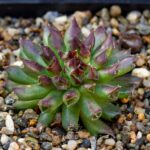
Lapidaria margaretae
Lapidaria margaretae forms clusters of pale, stone-like leaves with sharp, keel-shaped edges. This succulent mimics the color and texture of quartz fields to blend into its surroundings. It creates a low, compact rosette that eventually produces offsets from the base. The foliage retains a distinct white to pink-grey hue that intensifies under bright light.
Origin and Natural Habitat
This plant originates from the arid Karoo region of South Africa. It grows in stony, exposed plains where it survives in harsh, drought-prone conditions. It relies on the surrounding quartz to shield it from extreme sun exposure.
Plant Characteristics
The plant body consists of three to four pairs of thick, fleshy leaves. Each leaf reaches 3 cm to 4 cm in length. The surface color ranges from white to pale pink-grey. It produces large, bright yellow flowers during the autumn and winter months. The roots are thick and fleshy, requiring space to grow downward.
Care Guide
Light
Provide full, direct sunlight. Insufficient light causes the leaves to stretch and lose their compact, stone-like form.
Soil
The roots require immediate drainage to prevent rot. Use LDP Super Drainage Mix to facilitate healthy root growth and prevent water retention.
Water
Water heavily during the active autumn and spring growth cycles. Stop all water completely during the summer dormancy. Allow the substrate to dry out fully before you apply more water.
Pot Size
Use deep pots to accommodate the long taproot. Avoid wide, shallow containers that trap excess moisture near the base.
Temperature
Keep temperatures between 10°C and 25°C. Protect the plants from hard frost during the winter months.
Humidity
Maintain low humidity and high airflow. Stagnant air around the plant body encourages fungal issues.
Fertilizing
Apply a diluted, low-nitrogen succulent fertilizer once during the autumn growth period. Do not feed during the rest of the year.
Growing Season
Lapidaria margaretae grows primarily during the cool autumn and spring months. It enters a dormant state during the peak summer heat. Adjust your watering schedule to match these seasonal cycles.
Propagation
You can propagate this species through seed or division.
Seed: Sow the tiny seeds on the surface of a sterilized, sandy mix during autumn. Cover the container to maintain high, consistent moisture. Remove the cover gradually after germination occurs to harden the seedlings. Keep the young plants in bright, indirect light for the first year.
Division: Carefully lift the cluster from the pot during spring. Use a sterile blade to separate the heads. Ensure each segment retains a portion of the taproot. Plant the divisions in a dry, mineral substrate. Wait one week before applying light water to allow the cuts to callus.