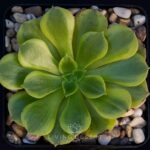
Echeveria ‘Romeo’
Echeveria ‘Romeo’ forms a massive, flawless rosette of thick, fleshy leaves flushed with an intense purple-red to deep burgundy coloration. This highly coveted selection differs from other variants because its smooth leaf surfaces lack a heavy glaucous coating, exposing a polished, wax-like finish that intensifies under bright sunlight. The deep red leaf margins curve slightly inward, forming a tight cup-shaped head that retains its rich color palette throughout the entire year.
Origin and Natural Habitat
This plant is a stable somatic mutation selected from Echeveria agavoides ‘Corderoyi’ within a controlled cultivation facility. The ancestral wild species occurs natively on dry, rocky limestone cliffs and steep volcanic slopes throughout central Mexico, particularly in San Luis Potosí and Hidalgo. These wild ancestors grow at high elevations where they endure intense solar radiation, low atmospheric humidity, and fast-draining mineral soils. Horticulturists isolated and stabilized this specific dark red color sport through careful vegetative propagation to preserve the distinct waxy epidermal characteristics.
Plant Characteristics
The solitary rosettes of Echeveria ‘Romeo’ reach a mature diameter of 15 cm to 20 cm, rarely producing offsets from the base. The stiff, triangular leaves terminate in a sharp, dark red terminal spine that mimics the appearance of an agave plant. It produces arching, unbranched flower scapes up to 30 cm long during the spring and summer months. These pinkish-red stalks bear small, lantern-shaped blossoms that display bright yellow interiors. The plant maintains a shallow but highly efficient fibrous root system designed to absorb surface moisture rapidly.
Care Guide
Light
This colorful succulent requires six to eight hours of direct morning sunlight or bright, filtered afternoon sun to maintain its dark red pigment and tight leaf arrangement. Grow it under a light 30% shade cloth inside a professional greenhouse setting. Insufficient light causes the rosette to flatten out, fade to a dull green color, and lose its characteristic waxy shine.
Soil
The fine, fibrous roots require a highly porous growing medium to eliminate any risk of moisture stagnation. The LDP EcoGrit Mix provides the ideal foundation for this cultivar. Never plant this selection in heavy organic soils or unamended peat mixes that hold water around the stem base.
Water
Water the plant thoroughly during the spring and autumn growing months only when the mineral substrate dries out completely down to the bottom of the pot. Apply the standard soak and dry method faithfully. Reduce watering frequency significantly during mid-summer heatwaves and cold winter weeks to prevent root rot while the plant rests.
Pot size
Select a shallow, wide terracotta pot that matches the current diameter of the rosette. Terracotta allows moisture to evaporate evenly through the porous clay walls, which protects the lower leaves from damp soil. Leave roughly 2 cm of clear space around the perimeter of the outer leaves for easy watering access.
Temperature
This cultivar thrives in warm daytime temperatures between 18°C and 28°C. It tolerates the cool night air of the Western Cape winter well but requires absolute protection against severe frost. Move the container to a bright, frost-free indoor area or under protected greenhouse staging during severe winter cold fronts.
Humidity
Maintain low air humidity levels with excellent ventilation across the growing area. Stagnant, humid air represents a major hazard, as it triggers fungal stem rot and powdery mildew along the dense leaf joints. Use small electric fans to keep the air moving constantly around the plant canopy if you cultivate it indoors.
Fertilizing
Apply a low-nitrogen liquid succulent fertilizer diluted to one-quarter strength only twice a year, once in early spring and once in early autumn. Do not feed the plant during mid-summer. Excessive nitrogen fertilizers cause the leaf tissue to bloat and crack, permanently ruining the neat rosette symmetry.
Growing Season
Echeveria ‘Romeo’ grows actively during the spring and autumn months when night temperatures remain cool. It slows down growth during the peak heat of summer and enters a semi-dormant state during mid-winter. The plant requires minimal water and high ventilation during these rest periods to prevent thermal stress and root loss.
Propagation
You can propagate this rare cultivar successfully using individual leaf cuttings or by utilizing decapitation methods.
Leaf Cuttings
Gently twist a healthy, mature leaf away from the main stem during spring, ensuring the base detaches completely without tearing the tissue. The intact meristem cell cluster at the leaf base is essential for new growth. Allow the leaf to dry in a shaded room for one week until a firm callus forms. Place the callused leaf flat on top of a tray filled with dry quartz sand, keeping it warm and shaded until tiny roots and new plantlets emerge after several weeks.
Stem Decapitation
Cut the main rosette head cleanly away from the rootstock during early spring using a sharp, sterile wire or knife. Dust the open wounds on both sections with sulfur powder to prevent fungal infection. Allow the head to dry for two weeks until a thick callus develops across the stem base, then place it directly onto a pot of fresh mineral mix to root. Keep the remaining rooted stump in bright light, and it will produce multiple small offsets along the bare stem edges within two months.