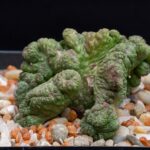
Conophytum truncatum
Conophytum truncatum forms tight, low cushions of flattened, button-like succulent heads covered in fine, dark green or purple dots. This specialized winter-growing geophyte hides from the elements by pressing its truncated, smooth grey-green bodies flat against the gravel line. The plant undergoes a complete annual transformation, withdrawing all its moisture into a paper-thin, dry sheath during the hot summer to protect the hidden new leaf pairs from drying out.
Origin and Natural Habitat
This species occurs natively across the southern regions of South Africa, primarily throughout the semi-arid Little Karoo and parts of the Great Karoo. The plants grow in northern-facing shale crevices, quartz fields, and under the protection of low karroid bushes. They survive in a winter-rainfall climate marked by intense summer heat, strong winds, and minimal annual precipitation. The fine epidermal spots function as miniature windows that diffuse intense solar radiation, allowing safe photosynthesis to occur deep within the buried succulent bodies.
Plant Characteristics
The individual obconical bodies of Conophytum truncatum measure only 10mm to 15mm in diameter, clustering tightly over time to form dense mats of over one hundred heads. The top profile remains distinctly flattened or slightly concave, split by a tiny central fissure. It produces nocturnal, daisy-like flowers during autumn that release a strong, spicy scent to attract nocturnal moth pollinators. These blossoms display variations of straw-yellow, cream, or pale pink petals that emerge directly from the central slit.
Care Guide
Light
This dwarf succulent requires bright, indirect sunlight or morning sun to preserve its compact profile and intense dot markings. Provide light shade cloth protection during fierce mid-summer afternoons to prevent the dormant bodies from scorching. Inadequate light forces the heads to stretch upward and turn green, which weakens the outer skin and causes standard rot.
Soil
The fine, shallow roots demand an exceptionally porous mineral growing medium to avoid moisture stagnation. The LDP Super Drainage Mix provides the perfect gravelly base for this Karoo native. It combines fine pumice, grit, and zero organic matter to let water pass through instantly. Avoid rich garden soils or commercial mixes that hold dampness.
Water
Water the plant thoroughly from autumn through early spring only when the small heads start to wrinkle slightly. Apply the strict soak and dry method during this active growth cycle. Taper watering significantly in late spring as the weather warms. Stop watering completely during summer when the leaves dry down into papery, protective husks.
Pot size
Select a shallow, wide terracotta pot or pan that accommodates the horizontal spread of the clustering cushions. Terracotta is ideal because the clay walls breathe, accelerating the evaporation of excess water from the root zone. Avoid deep pots, as empty soil volumes trap stale water and trigger root collapse.
Temperature
This winter-grower thrives in cool conditions between 12°C and 22°C during its active phase. It tolerates light winter cold fronts well but requires total protection against severe frost. Move the container to a bright, frost-free location indoors or inside a greenhouse during mid-winter cold snaps.
Humidity
Maintain low atmospheric humidity at all times. This desert succulent requires excellent, continuous air movement around its button-like bodies to prevent fungal spotting. Avoid damp indoor areas, unventilated rooms, or closed glass terrariums.
Fertilizing
Apply a balanced liquid fertilizer diluted to one-quarter strength only once a year in early autumn as the plant breaks dormancy. Do not feed the plant during its summer rest phase. Excessive nutrients bloat the bodies, causing the outer skins to split apart and rot.
Growing Season
Conophytum truncatum activates in autumn as temperatures drop, breaking out of its dry summer sheaths to absorb water and produce flowers. It grows steadily through winter and enters a deep dormancy in late spring. The plant spends the hot summer months completely dormant inside dry wrappers, requiring absolute dryness and maximum air ventilation.
Propagation
You can propagate this species reliably through head division or by sowing fresh seeds in autumn.
Head Division: Gently split a mature clump during early autumn just as the plant breaks its summer dormancy phase. Use a sterile razor blade to separate individual heads, ensuring each cutting retains a small piece of the basal stem. Allow the offsets to dry in a ventilated room for three days to form a firm callus over the wound. Insert the base into a pot of dry quartz sand, withholding water until the cutting pushes out fresh roots.
Seed Sowing: Sow microscopic seeds in early autumn using a sterile, purely mineral seed-starting substrate. Scatter the seeds evenly across the surface but do not cover them, as they require light to stimulate germination. Mist the medium lightly to keep it damp, covering the container with plastic wrap to hold humidity. Germination occurs within one to two weeks, after which you must immediately remove the cover to maximize airflow.