Origin and Natural Habitat
A mutant form that occurred randomly during the tissue culture process in cultivation. This plant does not occur naturally.
Plant Characteristics
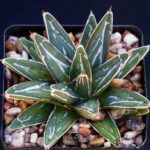
A mutant form of Haworthia atrofusca. ‘Watermelon’ has large rounded leaf windows, and grows in a more compact, robust rosette than the original species.
Care Guide
Light
Haworthia atrofusca ‘Watermelon’ prefers shade and will maintain its form well if kept under 60% shade cloth. It will not tolerate full sun.
Soil
‘Watermelon’ requires a very well-draining soil mixture with plenty of gritty components. A medium with akadama and pumice is preferred.
Water
In cultivation, Haworthia atrofusca can be watered well during the cooler months. However, reduce the amount of water it receives in summer when it is dormant.
Pot size
Haworthia atrofusca can grow into quite large clusters, but initially a 10cm pot will be sufficient. As they grow older, plant this species in a pot that is 5cm wider than its outermost leaves to accommodate new growth.
Temperature
This species’ ideal temperature ranges between 15 – 25°C. It can tolerate 5 – 35°C and is highly sensitive to frost.
Humidity
Haworthia atrofusca are sensitive to humidity. Make sure that your growing space has plenty of airflow. Flower stems may become moldy if kept in too high humidity.
Fertilizing
Use a half-strength diluted general liquid fertilizer only during the growing season. Do not fertilize during summer. Alternatively, a small amount of slow-release fertilizer will be sufficient.
Growing season
Haworthia atrofusca is in active growth during autumn, winter and early spring.
Propagation
Haworthia ‘Watermelon’ can be propagated from offsets only. Leaf propagations only produce normal Haworthia atrofusca.
Offset propagation: Using a sharp, clean knife, cut an offset of the Haworthia from the main stem. Let this dry for 5 days, then plant it. The best time to propagate is early autumn.