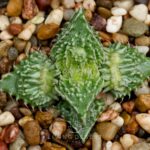
Haworthia bayeri f. variegata
Haworthia bayeri f. variegata exhibits flat, translucent leaf tips marbled with creamy-white and yellow variegation across compact rosettes. This rare form displays textured windows and orange variegation that set it apart from standard green forms.
Origin and Natural Habitat
This species is endemic to the Little Karoo in South Africa, specifically occurring in the area between Oudtshoorn and Uniondale. In nature, Haworthia bayeri often grows recessed into the ground under the shade of nurse bushes or tucked into rocky crevices.
Plant Characteristics
Haworthia bayeri is a solitary-growing species that rarely offsets, making it a sought-after species. The leaves are thick, fleshy, and form a compact rosette. The upper surface of each leaf is usually slightly scabrid (rough) or smooth, featuring distinct longitudinal lines and silvery flecks.
Care Guide
Light
Haworthia are shade loving plants, and it is best to grow them outdoors under at least 60% shade cloth. However, do not give them bright indirect light as this is not sufficient.
Soil
Haworthia are somewhat fussy about their soil mixes, and should be planted in a gritty, inorganic soil medium that drains well. A medium with Ibaraki Akadama or Hyuga pumice is ideal.
Water
This species can be moderately watered throughout the year, but make sure to water carefully during winter so that the soil does not stay too wet. Do not water during peak summer when it is very hot. Also, do not water on overly hot days as this may cause root rot.
Pot size
This genus grows relatively slowly. Small plants can be kept in 8cm pots until they start to grow near the edges of the pot, at which point they can be moved to larger pots. They should only be planted in a pot that is 3-5cm wider than their outermost leaves.
Temperature
Haworthia prefer temperatures between 10 – 25°C. This genus can tolerate 5 – 30°C. All Haworthia are sensitive to frost.
Humidity
Haworthia are semi-arid plants and are somewhat sensitive to humidity. Flower stems tend to succumb to mold if humidity is too high. Make sure that your growing space has plenty of airflow.
Fertilizing
Use a half-strength diluted general liquid fertilizer only during the growing season. Do not fertilize during autumn or winter. Alternatively, a small amount of slow-release fertilizer will be sufficient.
Growing Season
Haworthia are in active growth during autumn, early winter and spring, but their growth slows down somewhat in mid-winter, and they are dormant in summer.
Propagation
Since Haworthia bayeri rarely produces offsets, propagation is more challenging than with other Haworthia species.
Seed germination: This is the most common method for this species. Sow seeds in autumn in a well-drained, sterile seedling mix. Keep the medium consistently moist and provide bright, indirect light. Using a humidity dome or an airtight container for the first few months will help the tiny seedlings establish their root systems. Be patient, as H. bayeri seedlings grow remarkably slowly compared to other succulents.