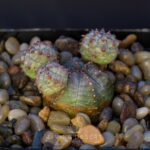
Tylecodon buchholzianus
Tylecodon buchholzianus grows as a dwarf, heavily branched shrub with extremely slender stems covered in peeling, papery bark. The tiny, succulent leaves often drop during the dry summer, leaving behind a delicate, bonsai-like skeleton. It possesses a unique, gnarly form that matures slowly in cultivation.
Origin and Natural Habitat
This plant occurs naturally in the arid, rocky regions of Namibia and the Northern Cape. It thrives in exposed, quartz-strewn habitats where rain arrives sporadically in winter. The plant adapts to these harsh conditions by shedding its leaves to reduce water loss during the heat of summer.
Plant Characteristics
The main stems reach a height of 10 cm to 15 cm. It branches freely from the base to create a dense, woody mass. The bark exfoliates in thin, brownish sheets as the plant ages. Small, tubular white to pale pink flowers appear on short stalks at the tips of the branches during the active growth season.
Care Guide
Light
Provide full sun or very bright, filtered light. Low light causes the slender stems to stretch and lose their natural, compact shape.
Soil
The roots require instant drainage to prevent rot. Use the LDP Super Drainage Mix for excellent aeration.
Water
Water moderately during the active winter growth phase. Allow the substrate to dry completely between applications. Withhold all water completely during the summer when the plant enters dormancy and drops its leaves.
Pot Size
Select shallow pots that allow the substrate to dry out quickly. Avoid deep containers that hold moisture around the root zone for too long.
Temperature
The plant prefers cool to moderate temperatures between 10°C and 25°C. It tolerates light frost but requires protection from severe winter cold.
Humidity
Maintain constant, active airflow. Stagnant humidity around the branches triggers fungal decay.
Fertilizing
Apply a weak, low-nitrogen succulent fertilizer once or twice during the active winter growth cycle. Do not feed during the summer dormancy.
Growing Season
Tylecodon buchholzianus grows actively during the cool autumn, winter, and spring months. It enters a dormant state during the hot summer to conserve moisture. Adjust your watering schedule to strictly match these seasonal cycles.
Propagation
You can propagate this species through stem cuttings or seed.
Cuttings: Remove a healthy branch segment during the autumn, just before the growing season begins. Allow the cut end to callus in a shaded, dry area for five days. Plant the cutting into a dry, gritty substrate. Keep the soil slightly damp to encourage root formation.
Seed: Sow the fine seeds onto the surface of a sterilized, gritty mix during autumn. Cover the pot with a clear lid to maintain consistent moisture until germination occurs. Remove the cover gradually to harden the seedlings against drier air. Keep the young plants in bright, indirect light for the first year.